Indonesia
 Deutsch
 Français
 हिन्दी


Get Discounts with our Digital Tourist Discount Pass
























Bali Weather
Bali is generally a year-round travel destination. However, weather plays a crucial role when planning your holiday in Bali.
Bali Weather with 2 distinct seasons
The climate in Bali, Indonesia is tropical, characterized by high temperatures and high humidity throughout the year. Bali is located near the equator (nearly 8 degrees south) and has two distinct seasons: the dry season, which runs from April to October and the wet or rainy season, which runs from November to March.
Visas IDP Travel eSIM

Best Time to Travel to Bali
The best time to visit Bali depends mainly on 2 factors that you should consider:
- Weather (sunshine, rainfall, temperatures, sea conditions)
- High or low season, (impact on prices for accommodation, airfares & flight tickets, and impact on how busy Bali gets particularly how much traffic-madness you will be exposed to)
When is the best time to visit Bali?
- The BEST months – The very best time to come to Bali are the months of May, June & September. This is the sweet spot if you are flexible in planning your holidays and don’t depend on school holidays.
- The GREAT months – weather usually great and not too busy: April, October
- The GOOD months – Great weather, but can be really busy: July & August. Weather alright, not busy
- The “to-RECONSIDER” months – January, February, December. Ask yourself, why would you come; and don’t make it about the beaches.
- Somewhere in-between and very unpredictable, can be great or bad: March and November
- Mid December to first week of January is a different experience altogether. Bad weather, and can get really crowded (south) – the typical “Christmas-NYE-Holiday-Season-Buzz”. Can be really fun too, lots going on, lots of events, parties, festivals.
Bali Weather Monthly Overview
January

Low Season
27 days rain
February

Low Season
22 days rain
March
Low Season
20 days rain
April

Mid Season
9 days rain
May

Mid Season
8 days rain
June

Mid Season
6 days rain
July
High Season
4 days rain
August
High Season
4 days rain
September
Mid Season
8 days rain
October
Mid Season
12 days rain
November
Low Season
16 days rain
December
Peak Season
22 days rain
Get Ready for Bali
All you need before getting into the plane
Visas Discounts Int. Driving Permit eSIMS & Data Hotels & Resorts Airport Transfer Customs Form Tourist Tax Medical InsuranceWhen is Bali the busiest?
Bali is busiest:
- Mid July to end of August it gets really busy – particularly in the Southern Hotspots (Canggu, Seminyak, Kuta, Ubud)
- Easter Time is reasonably busy
- Christmas & New Year (the absolute Busiest with heavy traffic in the south)
- Chinese New Year – many domestic tourists arrive
- End of Ramadan (Idul Fitri) – many domestic tourists arrive
Is busy bad?
Some Bali visitors love it when it’s busy, when the streets are buzzing and the restaurants are filled with guests from all over the world and all walks of life.
If you like it quiet and more serene, then Kuta, Legian, Ubud, Seminyak, and Canggu during high season might not be your first and best choice.
Still, even during high season, there are plenty of destinations in Bali, that are quiet and away from the masses. So, if you don’t like the crowds, just stay away from the coast between Kuta and Canggu. Destination Guide
When is Dry and Rainy Season in Bali
Dry Season in Bali
April to October
Less Rain – Cooler Breezes. Yes, COOLER breezes
During dry season, temperatures typically range between 80-90°F (27-32°C) and humidity is relatively low, while there is often a nice and cool breeze which is very pleasant – particularly during the evening (Bali’s Kite Season).
Most days are sunny, and dry, with little chance of rain – we are in the tropics after all, so expect the occasional rainfall.
During Bali’s dry season, beaches are generally clean(er), and Bali shows its pretty side. Simply the best time for all the amazing outdoor activities Bali has to offer, from rafting, canyoning, surfing, beaches and sunbathing to golf, cycling, trekking and climbing a volcano.
Rainy Season in Bali
November to March
More rain, hotter, much more quiet
Rainy season in Bali means simply more rainfall, higher humidity, and unfortunately trash on the beaches in the south and rough seas. Beaches in Kuta, Legian, Seminyak, Canggu, Pererenan and Jimbaran can be quite dirty due to debris and trash washed onto the shore.
The temperatures are still warm, typically ranging from 75-85°F (24-29°C). The island receives most of its annual rainfall, and it can be quite heavy at times causing occasional floods which can be quite unpleasant.
Usually, it does not rain all day, often, there are short spells of rain that might last a couple of hours in the afternoon and during nights.
It’s still possible to enjoy outdoor activities during this time of the year. The island’s lush tropical landscape is especially beautiful during the rainy season, with the vibrant green rice terraces and the jungle covered in mist.
Bali during RAINY SEASON is not the best time for beach enthusiasts but still amazing to explore culture, to wine and dine, party, shop, and for staycations. You can still be extremely lucky and experience sunny dies during rainy season but better expect regular and heavy rainfalls.
Climate Zones - The Different areas in Bali
1. Coastal Areas
The coastal areas of Bali, including places like Sanur, Kuta, Seminyak, Canggu, Padangbai, and Candidasa, are typically warm and humid year-round, thanks to their proximity to the sea. These areas experience a classic tropical climate with distinct dry and wet seasons. The dry season, from April to October, is generally sunny and breezy, ideal for beach activities and water sports. Temperatures usually hover between 27°C to 32°C, with humidity levels lower than during the wet season. From November to March, the wet season brings occasional heavy rains and higher humidity. While rainstorms can be sudden and intense, they tend to pass quickly, allowing for a mix of sun and showers. Some beaches get polluted with trash washing to the shore from during January and February.
2. Central Bali, Volcanos, Highlands and the Mountains
Bali’s central mountain area and the highlands are typically cooler and get more rain than the lower coastal areas. Especially at night, temperatures can drop significantly in the highlands near the volcanoes. The regions of Ubud, Sidemen, Kintamani, Bedugul, and Batukaru are situated at an altitude of around 600-1000 meters above sea level. These areas are cooler and experience more rainfall than the coastal regions. Due to the higher elevation, temperatures are milder, generally ranging from 20°C to 27°C. Rain is more frequent throughout the year, with the wet season (November to March) being particularly lush. Even in the dry season, it’s not unusual to experience occasional showers and morning mist, especially in Bedugul and Kintamani. This cooler, more humid climate supports Bali’s rice terraces, coffee plantations, and tropical forests, making it ideal for visitors who enjoy exploring nature.
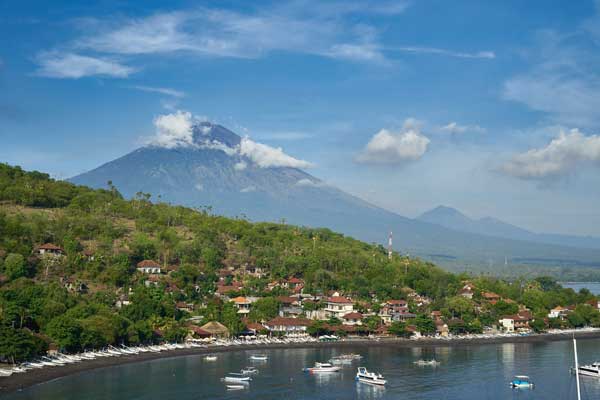
Mountains & Volcanos in Bali3. The Nusa Islands & Bukit Peninsula
The Bukit Peninsula, covering areas like (Nusa Dua & Benoa, Uluwatu & Pecatu, Ungasan) as well as the Nusa Islands (Nusa Lembongan, Nusa Ceningan, Nusa Penida), have a generally drier climate compared to the rest of Bali.
Here, the dry season is long, with lower humidity levels and less rainfall, even during the rainy months. Temperatures are warm, typically between 28°C to 32°C, and the landscape is characterized by cliffs, scrub, and dry forests. These areas do also face water shortages during dry season, and some hoteliers and villa owners might have to get water delivered by trucks, particularly in Uluwatu. The land is less fertile and the areas can struggle with fresh water supply. That’s why the development of golf courses and some of the developments did raise a lot of environmental concerns.
If you intend to visit the Islands and also the famous Gilis, then a boat ride can be quite an adventure – also during dry season.
Bali Climate Facts
Climate Chart Bali
What is the climate like in Bali? Have a look at the climate table, which should give you a good idea about temperatures during the day and the expected rainfall during dry season and rainy season. The chart represents the climate in Denpasar, Check our area map to see if your holiday area is located at the coast, or in highlands near volcanoes, or somewhere else.

Rainfall in Bali
How many days does it rain in Bali each month?
During dry season it sometimes does not rain at al, while on average on can say 3 to 6 days per month. During rainy season and depending on the area, it can go up to almost daily. See the stats below. Also check the section where we explain the different climate zones in Bali.
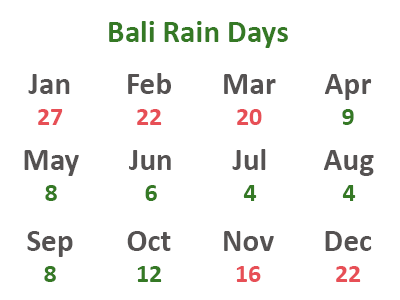
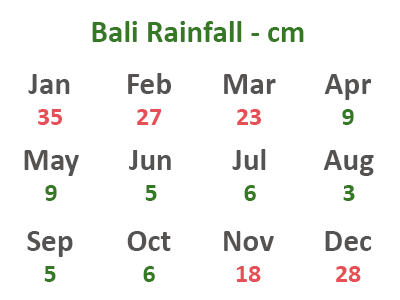
Monthly Weather Statistics for Bali
| General Weather Conditions in Bali per month | |||||||
|---|---|---|---|---|---|---|---|
| Months | max. Temp. | Rain days |
Rainfall | Season | |||
| Bali weather January | 26°C | 78°F | 27 | 34.5 cm | Rainy Season | ||
| Bali weather February | 26°C | 78°F | 22 | 27.4 cm | Rainy Season | ||
| Bali weather March | 26.5°C | 79°F | 20 | 23.4 cm | Changing Season | ||
| Bali weather April | 27°C | 80°F | 9 | 8.8 cm | Dry season | ||
| Bali weather May | 28°C | 82°F | 8 | 9.3 cm | Dry season | ||
| Bali weather June | 26.5°C | 79°F | 6 | 5.3 cm | Dry season | ||
| Bali weather July | 26.5°C | 79°F | 4 | 5.5 cm | Dry season | ||
| Bali weather August | 26.5°C | 79°F | 4 | 2.5 cm | Dry season | ||
| Bali weather September | 26.5°C | 79°F | 8 | 4.7 cm | Dry season | ||
| Bali weather October | 27°C | 80°F | 12 | 6.3 cm | Changing Season | ||
| Bali weather November | 27°C | 80°F | 17 | 17.9 cm | Rainy Season | ||
| Bali weather December | 26.5°C | 79°F | 22 | 27.6 cm | Rainy Season | ||